


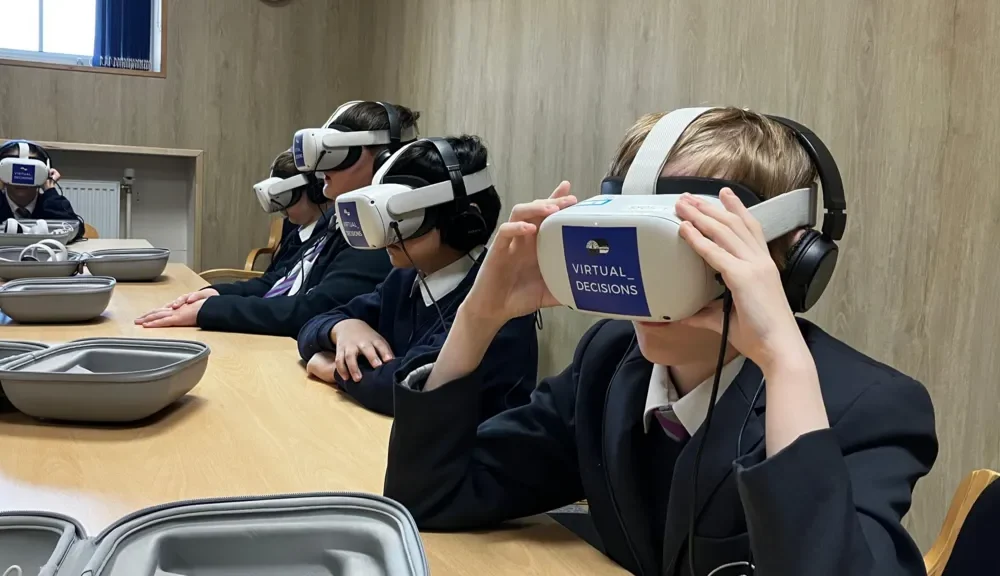
In a story that sounds almost like the plot of a future detective show, VR headsets are now part of the toolkit to help combat youth knife crime in Staffordshire, UK. Rather than merely relying on posters or stern lectures, officers are deploying immersive virtual reality experiences that let young people walk through the consequences of risky decisions — virtually and vividly. Facebook
The innovative programme has children and teenagers wearing VR gear to navigate scenarios where they make choices about carrying a knife. What could easily feel like “yet another authority talk” becomes much more real when you see the results of a poor choice unfold right in front of your eyes — even if it’s only in a digital world. staffordshire.police.uk
This creative pivot turns the usual image of police work on its head. Instead of just telling young people why a decision is dangerous, officers are letting immersive tech show them. And while no VR simulation can perfectly recreate every real-world nuance, the engagement and shock value of virtual scenarios can leave a lasting impression — one that may stick longer than a leaflet or an assembly talk.

Why This Matters: VR for Real Change
What happened in Staffordshire isn’t just a neat tech trick; it’s proof that VR isn’t only for games and enthusiast communities. This is public service, social change, and prevention in action. When police officers and educators use virtual reality as an education tool, they’re embracing the power of immersive experience to influence behavior — and that’s a belief we champion at VRGO. From safety training to emotional learning, VR offers ways to feel decisions before living them. Explore how VR applications are reshaping industries on our VR applications page at vrgo.site — this story is just one example of that shift.
There’s a certain optimism in watching communities experiment with such dynamic approaches. Rather than tugging at heartstrings with sad statistics, participants live a scenario with their senses engaged. It’s the kind of empathetic learning you just can’t get from reading bullet points in a classroom — the same reason VR training has taken off in healthcare, engineering, and business. See more on this in our feature on the impact of immersive training at vrgo.site.

A Future Where VR Makes Everyday Life Better
Now, you might wonder if all police forces will suddenly issue VR headsets instead of patrol cars. While that future remains speculative (and wonderfully cinematic), what we see in Staffordshire is an early example of practical application of VR beyond entertainment. This digital empathy — stepping into situations with realistic consequences — could well become a staple in education and outreach campaigns worldwide.
There’s an irony in using technology often associated with gaming to address one of society’s grimmest issues. But perhaps that’s the beauty of it. VR doesn’t replace real conversations or hard choices, but it enhances understanding and sparks reflection. In a world rapidly embracing virtual worlds, this is exactly the kind of real-world impact we love to share with our readers.
As immersive technology grows — and as stories like this show — VR’s potential to educate, inspire, and empower will only expand. If you’re curious how VR is already reshaping industries, culture, and communities, start with our insights at vrgo.site. The future doesn’t wait — and sometimes it arrives through a headset.
VRGO